Decorating with taxidermy – interior styling ideas for every room and style
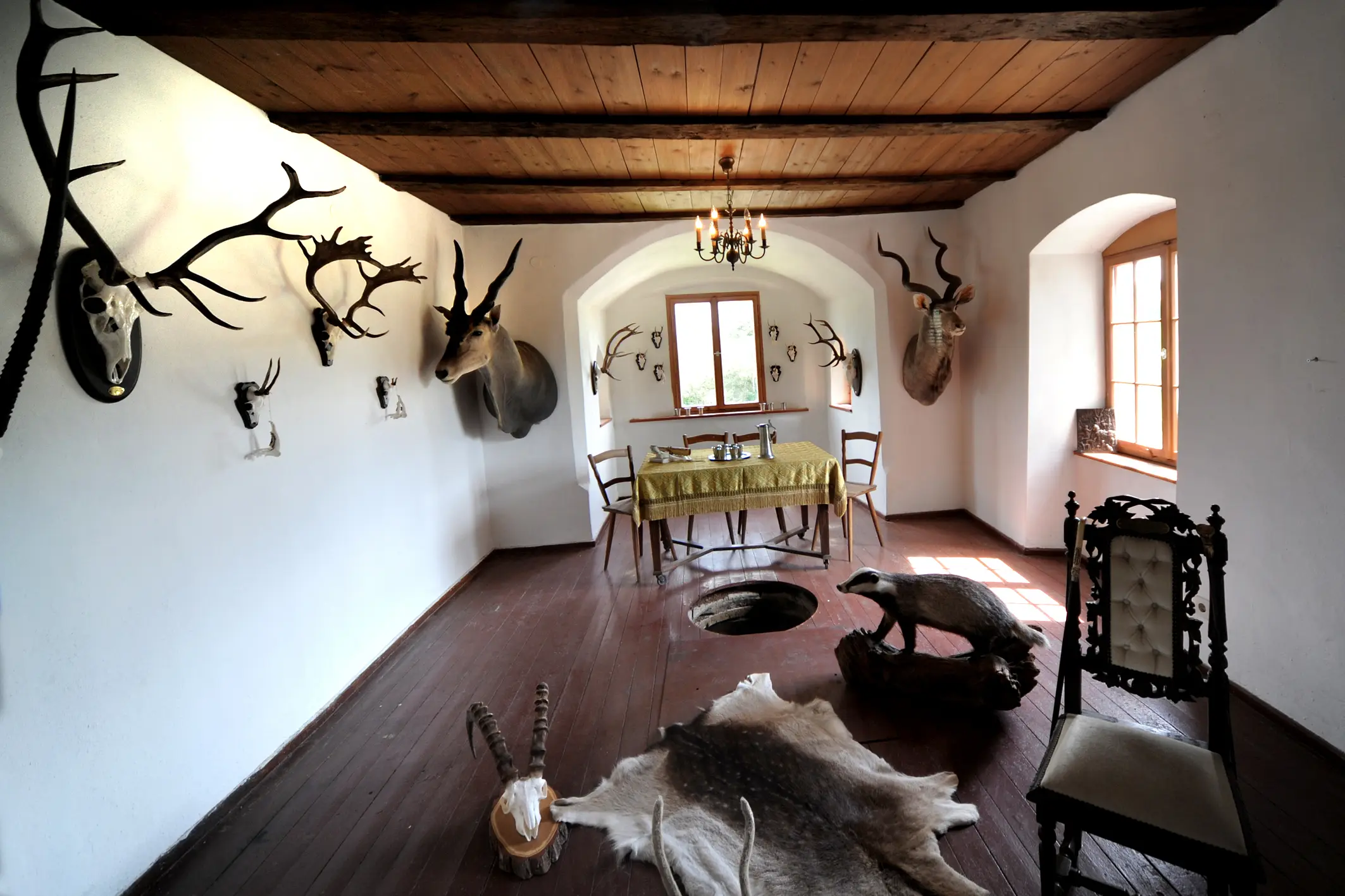
Photo: Holger Uwe Schmitt, CC BY-SA 4.0, via Wikimedia Commons
In short: Taxidermy works in any style when scale, background and light are right. Antlers and shoulder mounts suit a country house, a single statement piece suits minimalism, skulls and birds under glass suit dark academia, and large mounts become sculpture in a loft. A mount is a focal point – give it room.
Five styles, five effects
Country house and hunting lodge
The classic: antlers on shields, shoulder mounts of roe deer and red deer, hides on wooden floors, with linen, leather and wood. It feels contemporary when trophies hang in a strict grid against pale walls rather than in a crowded jumble – like the castle hunting room in our cover photo.
Modern minimalism
One mount on a plain plinth – a fox, a peacock, a kudu on a white wall – becomes a sculpture. Little else around it, plenty of space. Glass, stone and metal emphasise the natural texture of fur and feathers.
Dark academia and the library
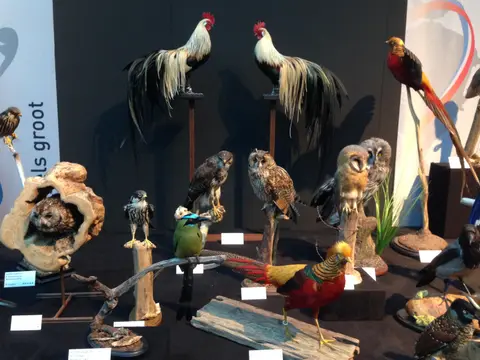
Deep walls in teal, forest green or aubergine, bookshelves, brass lamps – and among them skulls, birds under glass domes and insect cases. This style is the direct heir of the cabinet of curiosities.
Industrial and loft
High ceilings can take large pieces: a full wild boar, an antelope, a zebra hide on exposed brick. Raw concrete and steel contrast beautifully with fur and horn.
Scandinavian and natural
Light wood, wool and plants pair well with reindeer antlers, antler sheds, bird skulls and framed butterflies – less trophy, more natural find.
Room by room
| Room | What works | What to watch |
|---|---|---|
| Living room | a statement piece above a sideboard or fireplace, birds on a chest of drawers | not directly above an open fire; keep distance from seating |
| Study, library | skulls, glass domes, insect cases on shelves | good lighting, regular dusting |
| Hallway, stairs | antler groups, head mounts | hang high enough that nobody bumps into them |
| Bedroom | quiet pieces: butterflies, a bird under glass | no dust traps near the bed; avoid antique pieces with possible arsenic |
| Restaurants, hotels | groups, shoulder mounts, dioramas | sturdy pieces, glass or distance from guests |
Design rules that always work
- Scale: a large mount needs a large wall; small pieces gain impact in groups.
- Background: dark walls make fur and plumage glow; pale walls emphasise the silhouette.
- Odd numbers: groups of three, five or seven look more natural than pairs.
- Direction: animals should look into the room, not out of the window or at the door.
- Mix: combine mounts with books, plants, minerals, old prints and ceramics – a collection, not a trophy room.
Light and climate
Mounts like it cool, dry and shaded. Direct sunlight bleaches colours within a few years, radiator heat dries the skin and humidity attracts pests. Warm-white LED spots without UV show mounts at their best without harming them.
Mistakes to avoid
- Too many small pieces without order – it quickly looks like an attic.
- Mounts as toys or coat hooks – ears and antlers break.
- Large mounts in narrow passageways.
- Mounts on the outer wall of a cold, damp room.
Find your statement piece
Browse our collection by size class: S for shelves and dressers, M for sideboards and walls, L and XL for a grand entrance. Make sure the piece you choose is ethically sourced and documented – and if you are unsure, write to us with a photo of your room. We reply in English.
Frequently asked questions
Does taxidermy work in a modern home?
Yes – especially there. Against calm, plain walls a single mount reads like a sculpture. Choose a few strong pieces, leave space around them and use simple bases or glass domes.
Where should taxidermy not be placed?
Not in bathrooms or kitchens (humidity, grease, steam), not in direct sunlight and not above radiators. Antique mounts that may contain arsenic do not belong in children's rooms.
How should I light taxidermy?
With warm-white LED light without UV, from the side or at an angle from above. Raking light brings out fur and feather texture; a small spot makes glass eyes come alive.